National Alcohol Awareness Month
April marks Alcohol Awareness Month, providing an important occasion to enhance your understanding of Alcohol Use Disorder (AUD) and the detrimental effects of alcohol misuse on both individual health and societal well-being. The repercussions of alcohol-related issues persistently burden individuals, families, and communities. It is estimated by researchers that annually, over 178,000 deaths in the United States are attributable to alcohol-related causes, rendering alcohol a prominent and preventable contributor to mortality. Furthermore, more than 200 conditions, spanning from diseases to injuries, are linked to the misuse of alcohol.
Prevalence of Alcohol Use
According to the National Survey on Drug Use and Health (NSDUH), alcohol use and binge drinking are declining among 12–20-year-olds, but declines are faster for males. (1,2)
How do developmental changes in the brain increase alcohol misuse and related harms?
Motivation to socialize and explore the world is high during adolescence but areas of the brain involved in planning and decision-making (the prefrontal cortex) are the last areas to mature, typically into the mid-20s.
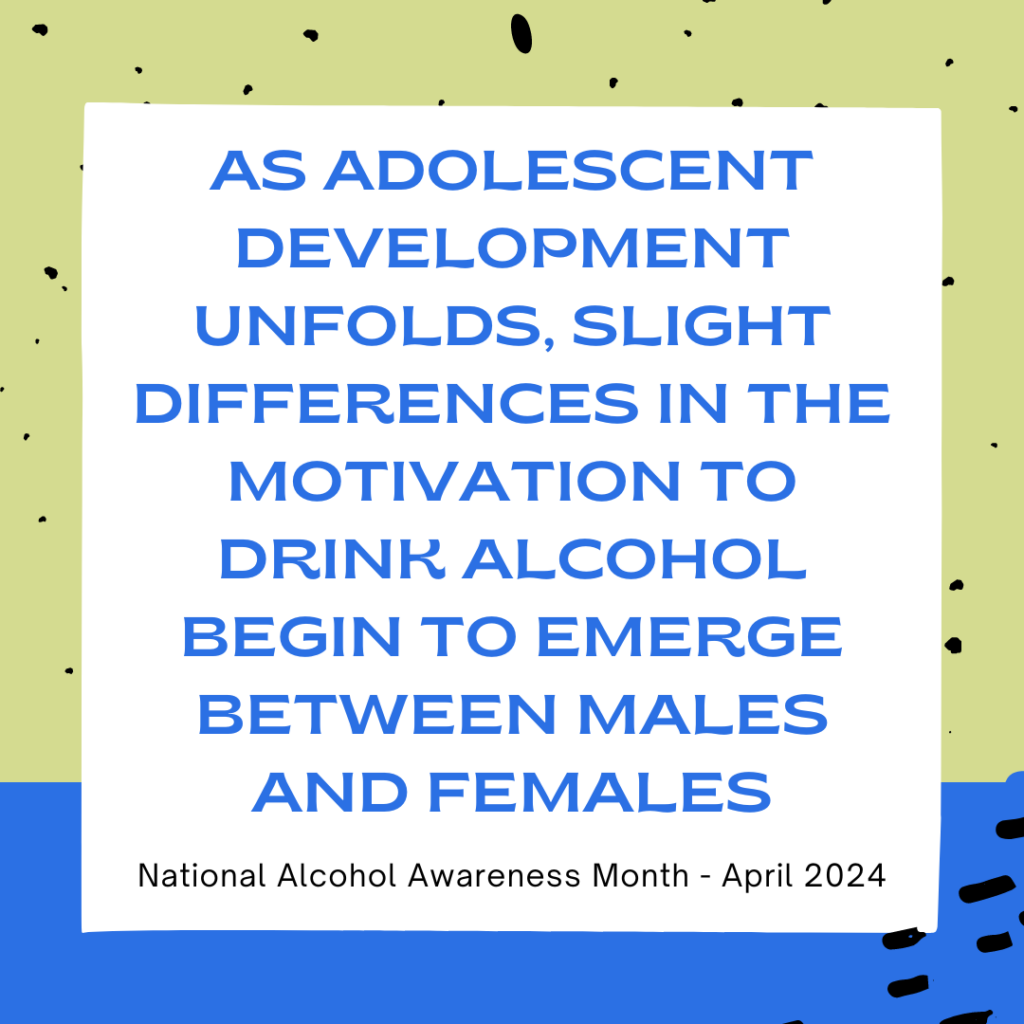
Research also suggests that, as adolescent development unfolds, slight differences in the motivation to drink alcohol begin to emerge between males and females. (Kuntsche et al., 2005)
Sensation-seeking is a motivation during adolescence, but more so for males. Females show smaller increases in sensation seeking during adolescence than males. Impulsivity also plays a role during adolescence but is more strongly related to alcohol use in males. (3)
In adolescent girls, stressful experiences and comorbid internalizing disorders may mediate substance use, which makes females more likely to drink via negative reinforcement. (4)
More young people report drinking alone on their last drinking occasion. Drinking alone is associated with drinking to cope with stress. (1, 2)
Females are generally about twice as likely to experience anxiety and depression during adolescence than males (Merikergas et al, 2010), which may be linked to drinking for negative reinforcement.
The good news is that the ability of the brain to change during adolescence can also lead to recovery from some alcohol-induced changes.
(NASEM, 2019)
How to Prevent Underage Alcohol Misuse
Research suggests that helping young people cope with changes during adolescence and exposure to adverse childhood experiences can have a positive impact on their decisions about alcohol and other substance use.
Examples of evidence-based protective factors include:
- Regular exercise
- Social support / social connectedness
- Good sleep practices
- Mindfulness training
- Motivational interviewing
In an ongoing clinical trial, NIAAA-funded researchers are testing the efficacy of new intervention approaches, like Substance-Free Activity Sessions and Relaxation Training, to provide tools to reduce stress and develop mood-enhancing behavioral substitutes for drinking for emerging adults. (Murphy 2022)
Resources
- This Health Topic webpage contains a curated list of NIAAA resources on underage drinking and advice for adults on how to discuss alcohol with kids and teens.
NIAAA Web Resources for Youth
- NIAAA for Middle School: Contains interactive activities to help parents, caregivers, and teachers introduce and reinforce key messages about peer pressure, resistance skills, and other topics related to underage drinking.
- NIAAA for teens: A research-based online resource for teens highlighting how health affects your health, warning signs and symptoms, and where to get help for alcohol-related problems.
NIAAA Resources for Young Adults
- College Drinking Prevention: A comprehensive, research-based resource for issues related to underage drinking in college.
- The College Alcohol Intervention Matrix (CollegeAIM): Helps schools identify effective evidence-based alcohol interventions for college students.
- Alcohol Interventions for Young Adults: Curated information about individual- and environmental-level strategies to prevent and treat alcohol misuse in young adults from health care professionals to policymakers.
NIAAA Resources to Improve Screening, Brief Intervention, and Referral to Treatment
- Alcohol Screening and Brief Interventions for Youth: A Practitioner Guide: Can be used in health care, school, and juvenile justice settings as guidance for health care providers and professionals.
- Healthcare Professional’s Core Resource on Alcohol: Helps healthcare professionals improve care for people of all ages whose alcohol consumption may be impacting their health, including tools for screening brief intervention, and referral to treatment.
According to the 2022 National Survey on Drug Use and Health (NSDUH), 17.5 million young adults ages 18 to 25 (50.2% in this age group) reported that they drank alcohol in the past month. (1, 2)
This includes:
8.5 million males ages 18 to 25 (48.6% in this age group) (1, 2)
9.0 million females ages 18 to 25 (51.8% in this age group) (1, 2)
According to the 2022 NSDUH, 10.3 million young adults ages 18 to 25 (29.5% in this age group) reported binge drinking (a pattern of drinking alcohol that brings blood alcohol concentration to 0.08% or more) in the past month. (5, 6)
This includes:
5.0 million males ages 18 to 25 (28.5% in this age group) (5, 6)
5.3 million females ages 18 to 25 (30.5% in this age group) (5, 6)
According to the 2022 National Survey on Drug Use and Health (NSDUH), 221.3 million people ages 12 and older (78.5% in this age group) reported that they drank alcohol at some point in their lifetime. (1, 2)
This includes:
110.2 million males ages 12 and older (79.7% in this age group) (1, 2)
111.1 million females ages 12 and older (77.3% in this age group) (1, 2)
- NIAAA. What colleges need to know now. Bethesda (MD): NIAAA; 2007 Nov. Defining binge drinking; p. 2. https://www.collegedrinkingprevention.gov/media/1College_Bulletin-508_361C4E.pdf
- SAMHSA, Center for Behavioral Health Statistics and Quality. Results from the 2022 National Survey on Drug Use and Health: detailed tables: appendix A: key definitions for the 2022 National Survey on Drug Use and Health. [cited 2023 Dec 7]. Available from: https://www.samhsa.gov/data/report/2022-nsduh-detailed-tables
- Shulman et al. Sex Differences in the Developmental Trajectories of Impulse Control and Sensation-Seeking from Early Adolescence to Early Adulthood. J Youth and Adolescence, 2015, 44, 1-17
- Hammerslag LR, Gulley JM. Sex differences in behavior and neural development and their role in adolescent vulnerability to substance use. Behav Brain Res. 2016 Feb 1;298(Pt A):15-26. PMID: 25882721
- Johnston LD, Miech RA, O’Malley PM, Bachman JG, Schulenberg JE, Patrick ME. Monitoring the Future National Survey Results on Drug Use 1975–2021. 2021 Overview: key findings on adolescent drug use. Ann Arbor (MI): Institute for Social Research, University of Michigan; 2022 Jan. Study design and methods; p. 10-1 Available from: https://monitoringthefuture.org/wp-content/uploads/2022/08/mtf-overview2021.pdf
- Hingson RW, Zha W, White AM. Drinking beyond the binge threshold: predictors, consequences, and changes in the U.S. Am J Prev Med. 2017;52(6):717-27. PubMed PMID: 28526355